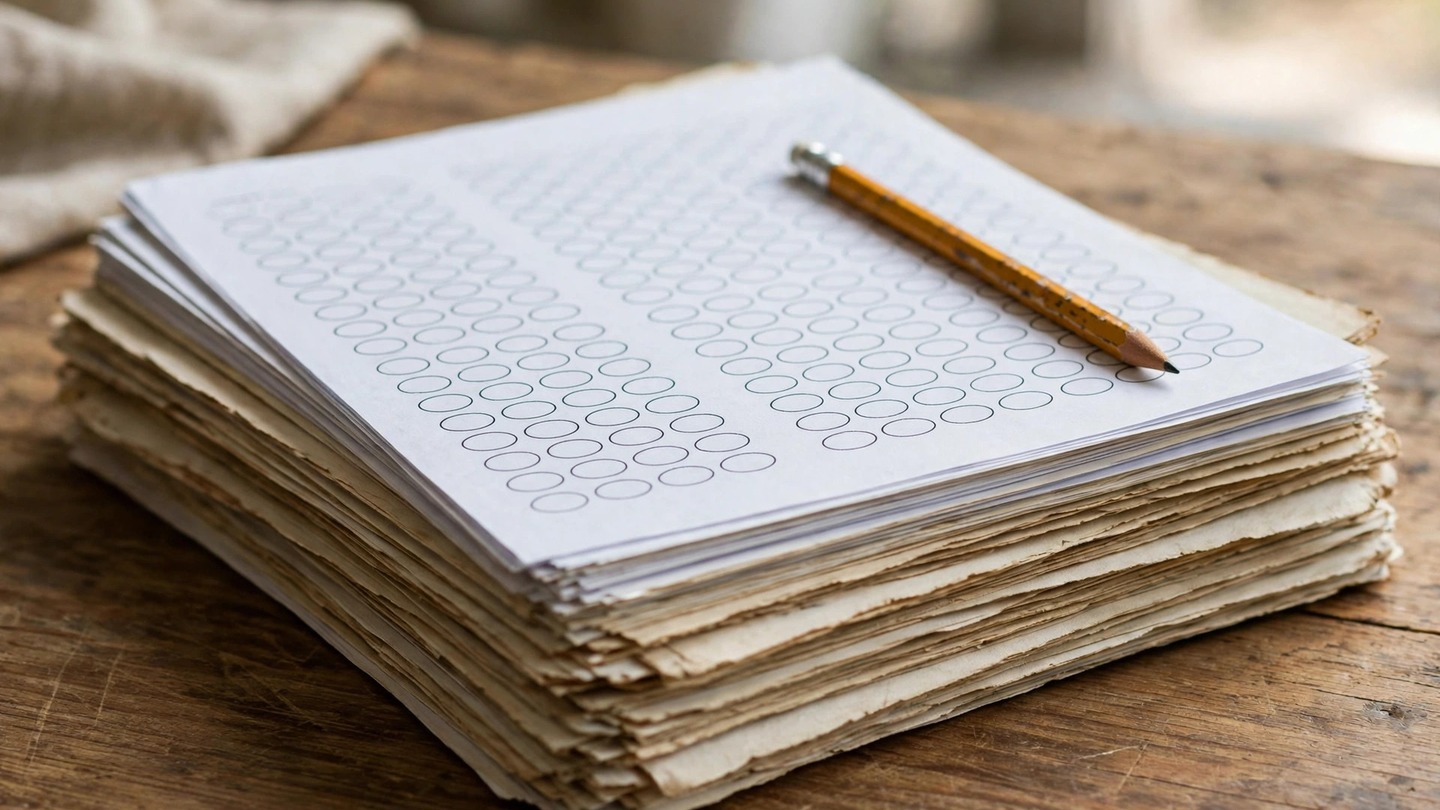
Mock Tests and Past Papers: The Smart Way to Prepare
Every topper says the same thing: mock tests and past papers are what turned preparation into selection. Books teach you the syllabus; mocks teach you the exam. Yet most candidates either skip mocks until the last week or take them without analysing the results. Both mistakes cost ranks. Here is how to use mocks and past papers properly.
1. Past papers show you the real syllabus
The official syllabus tells you what could be asked; past papers tell you what is actually asked. Collect the last five years of past papers for your exam and mark the topics that repeat. Those repeating topics are your priority list — they will almost certainly appear again. The General Knowledge MCQs and subject sets on this site are built around these repeating patterns.
2. Mocks measure what books cannot
Only a timed mock tells you your real speed, your accuracy under pressure, and which topics leak marks. Take your first mock early — even before you feel ready. A low first score is useful information, not a failure: it shows exactly where to focus the next month of study.
3. Analyse every mock the same day
A mock you do not analyse is just practice in making the same mistakes. After each mock, sort your wrong answers into three groups: concepts you did not know, questions you knew but answered carelessly, and questions you ran out of time for. Each group has a different fix — study, attention, or speed — and fixing the right one is what raises the next score.
4. Build a weekly mock routine
One full mock per week is the minimum. In the final month, raise it to two or three. Use the dedicated mock categories here — FPSC Mock Test 1 and MDCAT 2027 Mock Test 1 — so your practice matches the real paper format. Keep a simple record: date, mock name, score, and the weakest topic. Watching the weakest topic change week by week is how you know the preparation is working.
5. The final week: mocks only, no new books
In the last seven days, stop learning new material. Re-attempt your error log, redo your weakest mocks, and revise your one-page formula and facts sheet. New books in the final week create confusion, not marks. Arrive at the exam having practised the paper many times already — the real thing should feel like just another mock.
Preparation is not complete when you finish the syllabus. It is complete when your mock scores stop rising and your mistakes stop repeating. Start your first mock this week.
6. How to build your own mock from past papers
If your exam has no ready-made mock available, build one yourself from past papers — it takes an hour and it is one of the best preparation exercises there is. Start by collecting the last five years of past papers for your exam and counting how many questions came from each subject or topic. That count becomes your blueprint: if Biology supplied about half the questions, your mock should too. Then pick questions in the same proportions, mix them in random order, and set a timer for the same total time as the real paper.
Use fresh questions for the mock, not ones you have already attempted — a mock you have seen before measures memory, not ability. Keep the answer key separate and mark yourself strictly, with no partial credit and no extra time. The MDCAT 2027 preparation guide shows how the MDCAT paper is weighted by subject, which is a useful blueprint when you build a mock for any medical entry test. For FPSC and other competitive exams, the FPSC exam preparation strategy explains how English, GK and subject questions are balanced in the paper, so your homemade mock matches the real thing. Build one mock per week this way, and keep every mock paper and score in one folder — by the final month you will have a personal archive that shows exactly how far you have come.
7. The error log: your most valuable study tool
The analysis step is where most candidates give up, because it feels slower than doing more questions. It is also where the marks are. After every mock, open a notebook or spreadsheet and record every wrong answer with four entries: the question, the correct answer, the reason you got it wrong, and the topic. Then sort the reasons into three groups. "Did not know" means you need to study that topic again. "Knew it but answered carelessly" means you need to slow down and read the question twice. "Ran out of time" means you need timed practice on that question type.
Each group has a different fix, and fixing the right one is what raises the next score. A candidate who studies harder but keeps misreading questions will not improve, because the problem was never knowledge. Re-attempt every logged question after seven days; if you get it wrong a second time, it stays in the log and gets a second revision. In the final week, your error log becomes your revision plan — it is a short, personal list of exactly your weak spots, which no book can give you. The tips for solving MCQs faster explain the timed techniques that fix the "ran out of time" group, including how to skip a hard question and return to it instead of losing three minutes on one mark. Treat the error log as a living document, not a one-time exercise, and it will quietly become the most valuable thing you own in the final month.
8. What a good mock score really means
Mock scores are only useful if you read them correctly. First, a single mock score means almost nothing — what matters is the trend across four or five mocks. A rising trend means your method is working, even if one mock dips. A flat trend for three mocks in a row means the method needs to change, not the hours. Second, look at the score by subject, not just the total. A total of 70 percent can hide a Biology score of 85 percent and a Physics score of 50 percent, and it is the Physics score that needs the next week of work.
Third, separate accuracy from speed. Count how many questions you attempted, how many you got right, and how many you left blank. If you attempted everything and got many wrong, you are guessing too much — skip the questions you cannot narrow down to two options. If you left many blank, you are too slow — practise in timed batches of 20 questions, such as the Top 100 Physics MCQs, which are ideal for speed drills because Physics questions are the slowest to solve. Finally, never compare your mock score with someone else's. Different mocks have different difficulty, and the only comparison that matters is your own score last week. A mock is a mirror, not a ranking — use it to see yourself clearly, fix what it shows, and walk into the real paper having already sat it many times in practice.